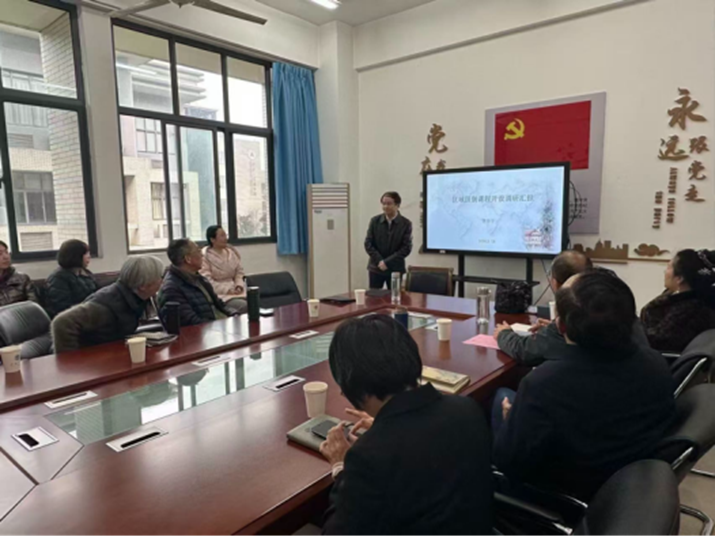
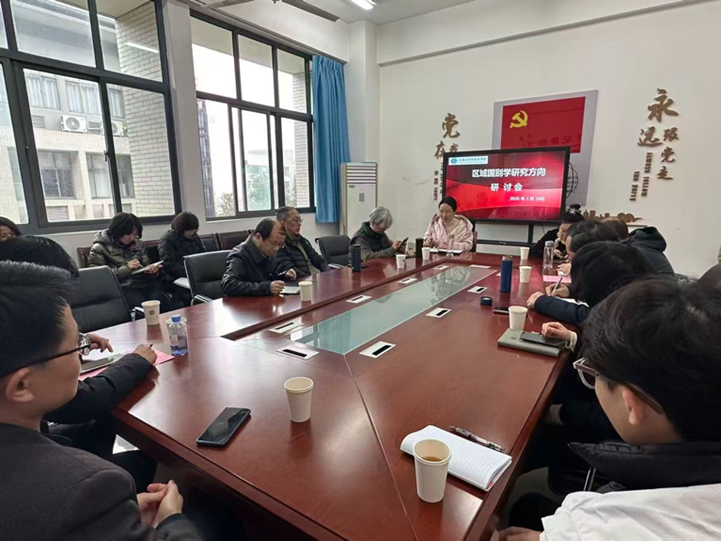
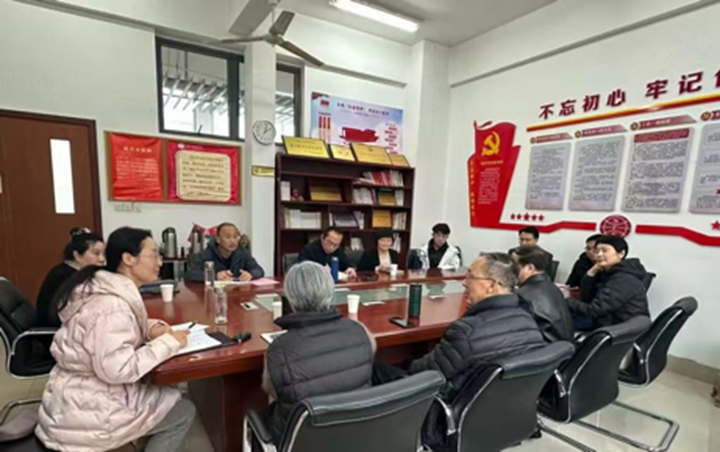
To align with national strategic priorities and advance the high-quality development of foreign language disciplines, the School of Foreign Studies at Jiangnan University held a symposium on area and country studies on the afternoon of March 18, 2026.
Chaired by Vice Dean Xie Jingxian, the symposium was attended by Party Secretary Li Ronghua, Dean Fang Wenkai, Vice Deans Gu Qiyi and Yang Yong, Li Xuening, Director of the Master of Translation and Interpreting (MTI) Program, and 11 other scholars and experts. Participants held in-depth, multi-faceted discussions on key issues concerning area and country studies.
In her opening remarks, Vice Dean Xie Jingxian presented feedback from the expert panel of the special evaluation. She stressed that the development of foreign language disciplines must adhere to two core orientations:
First, research directions should closely follow the 15th Five-Year Plan and be integrated with national strategic needs.
Second, efforts should be rooted in Wuxi’s local development priorities, aligned with local industrial strengths, and focused on the university’s key development fields including food health, biomanufacturing, and artificial intelligence, so as to ensure disciplinary development is consistent with the overall planning of the nation, the region, and the university.
Li Xuening then addressed the current landscape of the industry. He noted that foreign language majors are facing dual pressures from profound shifts in the industrial structure and the rapid advancement of AI technologies. The traditional teaching advantages of high-resource languages are gradually diminishing, while low-resource languages have become an important breakthrough point for disciplinary development. Successful practices in area and country studies at domestic universities offer valuable references.
Furthermore, the model of “Key Languages + AI + Area and Country Studies” has emerged as one of the core pathways for the development of foreign language majors, and disciplinary construction must center on this orientation. Research indicates that universities outside the top tier can achieve disciplinary breakthroughs and avoid homogenized research by focusing on specific regions and conducting in-depth, targeted studies.
More than 10 professors, including Gong Xiaobin and Yuan Xuesheng, shared distinctive insights from diverse perspectives. All participants spoke freely and put forward valuable suggestions. Focusing on the building of a community with a shared future for mankind, they proposed a variety of feasible pathways in light of national strategic directions for the next decade, drawing on their respective research fields and practical experience.
At the close of the symposium, Dean Fang Wenkai delivered a concluding speech. He fully affirmed the symposium’s pragmatic outcomes in confronting challenges directly and building consensus. He also laid out specific arrangements for follow-up work, emphasizing the need to grasp national strategic needs while exploring distinctive research perspectives, translate the school’s existing strengths into core competitiveness in area and country studies, and fully advance the school’s disciplinary construction.
Party Secretary Li Ronghua encouraged all participants to further consolidate consensus, refine research directions, and strive for high-level research achievements.
This symposium has built consensus for the reform and development of foreign language disciplines and the planning and development of area and country studies at Jiangnan University.
Moving forward, the School of Foreign Studies will further refine its featured disciplinary directions, improve its discipline development plan, and promote the deep integration of foreign language disciplines with area and country studies. It will build a disciplinary system featuring Jiangnan characteristics, national vision, and regional value, support the university’s “Double First-Class” initiative, and contribute Jiangnan’s strength to national strategies and local economic and social development.